
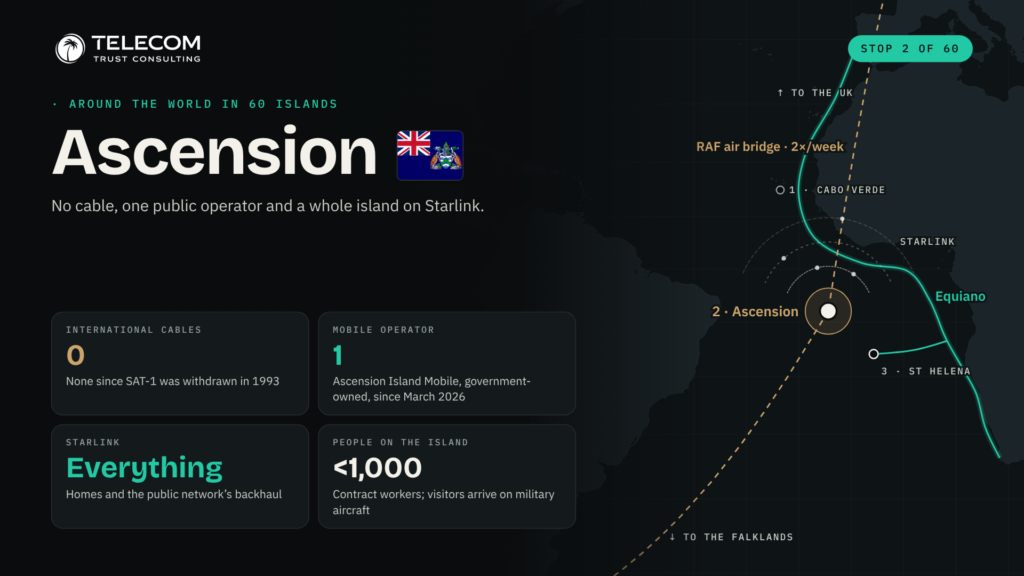
No subsea cable since 1993. One mobile operator, owned by the government. Fewer than 1,000 people, and almost no tourists. The second stop on our route is the Ascension Island telecom market, the opposite of Cabo Verde: a British military outpost in the middle of the South Atlantic where homes and the public network now leave the island through the same satellite constellation.
In 30 seconds
- No cable at all: SAT-1 was withdrawn in 1993 and nothing has landed since. Every byte leaves by satellite.
- One operator, built by the government: Sure left on 28 February 2026 and Ascension Island Mobile (AIM) went live two days later.
- Everything rides on Starlink: most homes use their own terminals and AIM’s backhaul is Starlink too. In April 2026, a network failure was traced to that link.
- A gigabyte 13 to 60 times cheaper than with Sure: £2–6 today against £80–120 in 2025.
- No tourists: most people who fly in arrive on military aircraft, and those who live there are contract workers. Without roaming, their own phones do not work on the island.
Ascension in numbers
people (latest official estimate, March 2023)
international cables since 1993
mobile operator: AIM, government-owned, 4G
AIM services: 250 homes and 250 businesses
per GB on AIM mobile plans
roaming agreements in force
An island of workers, where visitors arrive by military aircraft
Ascension has no indigenous population and no right of abode. Everyone on the island works, or is family of someone who works, for the Ascension Island Government (AIG), the British and US bases or their contractors. Most are St Helenians, British and American. The latest official estimate counts 894 people, and the AIG talks of about 800 at any one time.
Where people live · 2008 estimate
Unconfirmed 2008 estimates, the only split by settlement available (St Helena Statistics Office). Two of the five settlements are military bases and house four in ten residents.
The bases set the pace. RAF Ascension Island (Wideawake Airfield) is shared by the Royal Air Force and the US Space Force, and it is the refuelling stop for the twice-weekly air bridge between RAF Brize Norton and the Falkland Islands. Entry from that flight is limited to military and contracted personnel with sponsored visas, plus passengers in transit. Up to fifteen civilian seats per flight and a monthly Airlink charter from St Helena are the only other ways in.
Who flies in
military air bridge flights UK–Ascension–Falklands
civilian seats per air bridge flight, at most
commercial flight: Airlink from St Helena
tourism statistics published
Every visitor needs an e-visa (£40 for tourists since January 2026). A 2019 report published by JNCC, the UK government’s nature adviser, described tourism as all but non-existent; today it is limited to a few sport anglers, yachts and researchers.
So most people who land on Ascension are military or work for the military, and many never leave the airfield. But those who live there are mostly civilians: the RAF runs the airfield with about 19 personnel, and the US station relies on contractors. For the network, that changes everything. There are no hotels to fill or cruise peaks to plan for, just a stable, rotating workforce that needs to call home, bank and study online, and has no alternative when the one network fails.
No cable since 1993, and a single constellation today
Ascension once sat on a cable route. That ended in 1993, when SAT-2 replaced SAT-1 and bypassed the island. Since then, two opportunities have passed by.
The cables that never came back
SAT-1
South Africa–Ascension–Cabo Verde–Tenerife–Portugal. Withdrawn in 1993; SAT-2 skipped Ascension.
South Atlantic Express (SAEx)
Planned an Ascension landing on its South Africa–St Helena–Americas route. Not built.
Equiano, St Helena branch
Google’s cable reached St Helena, about 1,300 km away. Ascension got nothing.
International redundancy
Very low
Domestic redundancy
Low
Until 28 February 2026, Sure South Atlantic connected the island through Intelsat’s IS-23 geostationary satellite. AIM did not replace that link. Today the civil island has, in practice, one way out:
How each user leaves the island
AIM traffic leaves the island with UK IP addresses.
That single exit has already failed. In April 2026 the Island Council minutes attributed a network failure to the external Starlink connection, and recorded that AIM was assessing a second low Earth orbit provider as backup. Another outage followed on 13 May, and by 18 June AIM had counted three, each fixed in under four hours. In May the government was buying satellite phone SIM cards as a contingency. Seven months after that first failure, no backup has been contracted.
Sure leaves, and the government builds an operator in three months
Sure had no exclusive licence on Ascension, so the AIG could authorise Starlink without compensating it. Once residents moved to their own terminals, Sure argued that such a small market could no longer sustain it. The Falkland Islands chose the opposite path: with Sure’s exclusive licence in force, the government agreed in 2025 to pay it up to £6.167 million for lost broadband revenue.
From Sure to AIM
- 1 May 2023Class licence for Starlink-type terminals: £10 a year each. About 150 were already in use.
- August 2025Sure announces it will leave at the end of February 2026 unless a new deal is reached.
- 12 November 2025The Island Council backs rejecting Sure’s revised subsidy proposal.
- 18 December 2025The AIG chooses a partner to build a new network.
- 28 February 2026Sure switches off fixed, broadband, mobile and its satellite link.
- 2 March 2026Ascension Island Mobile goes live. The UK Foreign Office invested £1 million; the RAF helped with logistics.
- 25 July 2026Starlink’s official residential service starts, from £40 a month.
One operator, and a gigabyte up to 60 times cheaper
AIM is, by definition, the whole market. In April 2026 it had 250 residential and 250 business customers, with about 900 services between mobile, fixed wireless and landline. It runs 4G with voice over LTE in band 5 (850 MHz) for coverage and band 3 (1800 MHz) for capacity. There is no 2G or 5G, and phones must be unlocked and support VoLTE.
Price per GB on mobile
AIM mobile plans · 30 days unless stated
| Plan | Data | Voice and SMS | Price |
|---|---|---|---|
| AIM High | 30 GB | Unlimited local | £60 |
| AIM Sharp | 15 GB | Unlimited local | £40 |
| Take AIM | 5 GB | 100 min, 100 SMS | £30 |
| AIM Short | 3 GB, 7 days | 100 min, 100 SMS | £10 |
Source: aimobile.ac (23 November 2026) and 2025 Sure prices. Prepaid only, no top-ups: when the allowance runs out, the customer buys a new plan. The Saint Helena pound is at par with sterling (£1 ≈ €1.20).
Fixed broadband arrives by radio or from orbit
Traditional fixed broadband disappeared with Sure’s network on 1 March 2026. There are now two ways into the home: AIM’s fixed wireless access over its 4G network, or a Starlink terminal contracted by each household. In August 2026 the Island Council noted that many residents had already signed up for Starlink. No penetration figures are published for either.
Home broadband · November 2026
| Operator | Plan | Speed and data | Per month |
|---|---|---|---|
| Starlink | Residential | 100 Mbps, unlimited | £40 |
| AIM | AIM True | Speed not published, 40 GB | £40 |
| AIM | AIM Together | Speed not published, 160 GB | £65 |
| AIM | AIM Far | Speed not published, 350 GB | £80 |
| Sure (closed) | Residential | 1 Mbps, 4 GB | £56.98 |
Sources: ISPreview, Starlink Insider and aimobile.ac. Starlink kit: £299 plus £20 shipping at launch, with a £179 kit also listed in October 2026.
The government as owner, licensor and regulator
Ascension has no independent regulator. The AIG licenses services under the Telecommunications Ordinance 1997, which is under review; as of November 2026 no new law has been passed. AIM holds a licence under that ordinance, and the AIG acts as regulator of a company it owns. There are no market reviews, cost models or spectrum auctions. AIM’s new governance framework, signed in July 2026, separates the company from the administration, and a permanent chief executive is expected from January 2027.
Rules of the game
Telecommunications Ordinance, under review
new numbering plan since 1 March 2026
mobile country code, shared with St Helena and Tristan da Cunha
What still does not work for the people who use it
On Ascension the user is not a tourist passing through but a worker who stays, plus a steady flow of military and contractors on rotation. For them the weak point is not speed but the link to the outside world.
Service checklist · November 2026
- ✓4G with VoLTE across the islandSeveral outages in spring 2026, each fixed in under four hours.
- ✓Home broadband from £40 a monthAIM fixed wireless or own Starlink terminal.
- ✗RoamingAn AIM line stops working when its owner flies out. Talks with BT since June; still pending.
- ✗Phones brought by arrivalsOverseas SIMs and travel eSIMs do not work. New arrivals must buy an AIM SIM at the Post Office in Georgetown.
- ✗Incoming international callsStill routed through temporary UK +44 numbers while +247 numbers are recognised worldwide.
- ✗Bank verification SMSNot arriving reliably in August 2026; AIM is negotiating with international suppliers.
- ✗A second way outNo backup to Starlink contracted yet.
The military are the exception: the bases rely on defence communications separate from AIM’s network.
How much capacity does that single exit need? With about 900 services, 10% of daily traffic in the peak hour and a busiest quarter-hour 1.6 times the hourly average, our estimate is that AIM needs between 160 and 640 Mbps at peak. That is several times what one residential Starlink terminal delivers, which is why a dedicated, sized backhaul and a second provider matter.
AIM backhaul at peak (estimate)
In-house estimate with the same peak assumptions used for Cabo Verde. AIM Far includes 350 GB a month, more than 11 GB a day, so the upper range is plausible.
Ascension vs the other stops
The first three stops
| 1 · Cabo Verde | 2 · Ascension | 3 · Saint Helena | |
|---|---|---|---|
| Int. cables | 3, one landing point | 0 since 1993 | 1 (Equiano branch, 2023) |
| Mobile operators | 2 | 1, government-owned | 1 (Sure) |
| Regulator | ARME | The island government | Communications Regulator (2025 law) |
| Starlink | Since Dec 2024 | Homes and AIM backhaul | Not allowed |
| Who uses the network | Residents and many tourists | Contract workers; visitors arrive by military aircraft | Residents and a few visitors |
St Helena, 1,300 km away and part of the same British territory, has fibre, a private operator, a new regulator and Starlink banned. Ascension has none of the first three and has bet everything on the fourth.
What’s next for the Ascension Island telecom market
When low Earth orbit arrived on an island with no cable, prices fell by an order of magnitude and the incumbent left. The island now depends on one constellation.
The government avoided a blackout with a public network built in three months. Three tasks remain open: a second, independent backhaul; a modern communications law that separates owner and regulator; and roaming and reliable international messaging for a population that is always coming and going.
Have more recent data? If you work in the sector on Ascension or see something that needs correcting (backhaul capacity, the split of AIM services or roaming progress), write to us and we will update the analysis.
Full report
Want the complete Ascension analysis?
This post is a summary. The full report goes deeper, with all the data, tables and the 49 sources behind this analysis.
Request the full reportFill in the form and mention “Ascension report” in your message. We will send it to you by email.
Around the World in 60 Islands
Next stop: Saint Helena.
Same territory, 1,300 km away: a fibre cable, a private monopoly and Starlink banned. Follow the route to see how it connects to the world.
Stop 2 of 60 · Two analyses a week
Main sources
- Ascension Island Government: AIM goes live, living on Ascension, travel by air, satellite class licence
- Island Council minutes: 23 April 2026, 18 June 2026, 27 August 2026
- Operator and prices: Ascension Island Mobile, ISPreview on Starlink, Sure prices 2025
- Sure’s exit: St Helena Online, Falklands agreement with Sure
- Access and visitors: ch-aviation on the air bridge, JNCC tourism report, RAF Ascension Island
- Cables: Atlantic-Cable.com, Equiano branch to St Helena
Full analysis with 49 sources, consulted between 18 and 23 November 2026; visitor data checked on 27 November 2026.