
15 January 2022. The eruption of the Hunga Tonga underwater volcano cuts the only cable linking Tonga to the rest of the world. For days, thousands of families across New Zealand, Australia and the United States have no idea whether their loved ones are safe. It takes five weeks for the connection to come back.
For most of us, communications are simply there. On many islands around the world, however, they depend on a cable at the bottom of the sea. Sometimes two. Sometimes none.
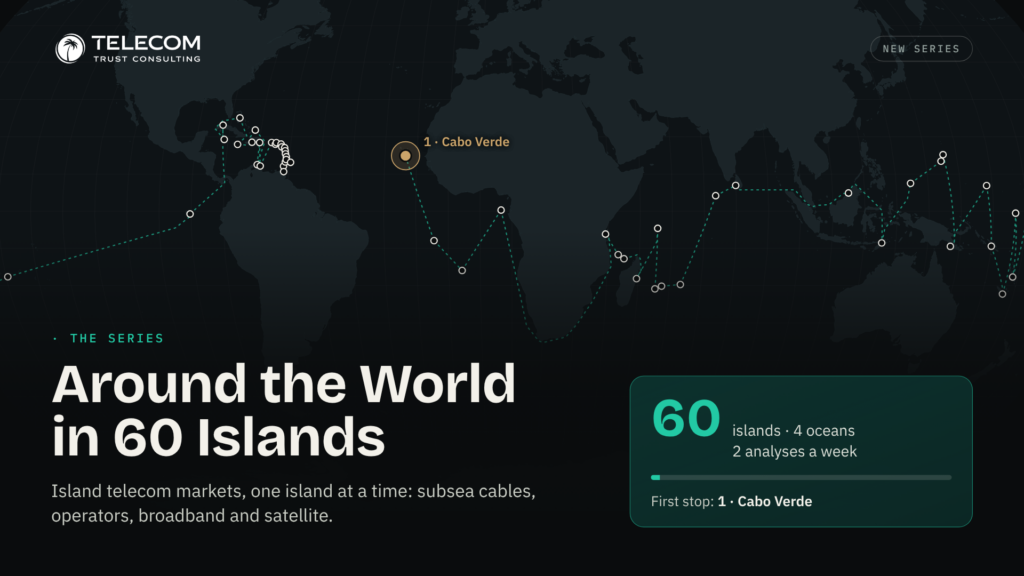
That is why we are launching Around the World in 60 Islands: a series of analyses of island telecom markets that, until now, almost nobody had studied side by side.
In 30 seconds
- 60 islands, 5 legs: from the Atlantic to the Caribbean, via the Indian Ocean, Asia and the Pacific.
- The same four lenses for every island: subsea cables, mobile, fixed broadband and satellite.
- The criterion: islands with their own market that rely on one or a few cables.
- Two analyses a week. First stop: Cabo Verde.
The islands in numbers
island markets on the route, from Cabo Verde to the Caribbean
without its only cable in Tonga after the 2022 eruption
for a 20 Mbps connection on Saint Helena, in the South Atlantic
round-trip latency over geostationary satellite
What the series is
Over the coming months we will travel through 60 island markets in five legs. We will publish two analyses a week, and every island will be looked at through the same four lenses, so they can be compared with each other.
What we analyse on each island
Which cables connect it and how much redundancy it has.
Which operators are there and how they split the market.
How many connections there really are, and on which technology.
The role it plays, and whether Starlink has arrived, is pending or is banned.
The route: 60 islands in 5 legs
Atlantic
Cabo Verde, Ascension, Saint Helena and São Tomé and Príncipe
Indian Ocean
From Zanzibar to Sri Lanka, via Madagascar, Mauritius, Seychelles and the Maldives
Asia
Brunei and Timor-Leste
Pacific
From Palau to the Galápagos: Micronesia, Melanesia and Polynesia
Caribbean
From Cuba to Barbados, across the Greater and Lesser Antilles
See the full journey on the interactive route map.
The first stop is Cabo Verde, an archipelago in the middle of the Atlantic, connected by several cables between Europe, Africa and South America, with Starlink authorised since 2024. A good starting point for understanding everything that follows.
What makes islands different
Connecting an island is not the same as connecting a city on the mainland. And distance is only part of the story.
One cable, one point of failure
On the mainland, traffic is rerouted when one route fails. Many islands have a single way out to the world. If the cable is broken by an earthquake, an anchor or a volcano, the island is cut off or has to fall back on far smaller satellite capacity. Repairs need a specialised ship and, depending on where the fault is, can take weeks.
One cable, one point of failure
Mainland
If one cable fails, traffic is rerouted
Island
One way out: if it is cut, the island is isolated
Illustrative diagram. On many islands on the route, international connectivity depends on one or two subsea cables.
Distance is also measured in milliseconds
Much of the content we use every day (video, social media, apps, games) is not hosted on the island but in data centres thousands of kilometres away. Every 1,000 km of fibre adds around 10 milliseconds of round-trip time, and traffic rarely travels in a straight line. If the island also lacks a neutral traffic exchange point and caching servers from the big content providers, every click crosses the ocean and back.
Round-trip time
Indicative values. Over fibre, around 10 ms round trip per 1,000 km, plus routing.
Over geostationary satellite, latency usually exceeds half a second. Low Earth orbit constellations such as Starlink and OneWeb bring it close to fibre, which is why they are changing the rules of the game on many islands.
Voice, data and TV: three different challenges
A call copes badly with latency and dropouts. International interconnection is expensive, and more and more calls travel over messaging apps, which depend on the quality of the data connection.
International capacity is an island operator’s biggest cost, and it shows in the final price: on Saint Helena, 20 Mbps can cost around £120 a month.
Many islands receive television by satellite, with rights negotiated regionally. Streaming eats into international capacity that is scarce and expensive when there are no local caches.
Small markets, extreme weather and their own rules
With populations of a few thousand or a few hundred thousand people, many islands only have room for one, two or three operators, and the regulator has to balance two things: protecting whoever keeps the network running and opening the market to new players. Add cyclones and hurricanes that can bring down masts and power grids in hours, expensive energy that often depends on diesel, and regulation that changes from one country to the next: while Cabo Verde authorised Starlink in 2024, other markets on the route still do not allow it.
Why we left out the Canary Islands, New Zealand, Malta , Japan and some others
Geographically they are islands, but in telecoms they play in a different league: they are part of large national or European markets, have multiple cables and alternative routes, share operators with the mainland, and have data centres and traffic exchange infrastructure close by. Their challenges are real, but they are not those of a market that depends on one or two cables.
On the route
- Its own telecom market, with its own regulator and operators
- One or a few subsea cables
- Satellite as backup
- Content and data centres far away
60 islands, from Cabo Verde to Barbados
Off the route
- Part of a large national or European market
- Many cables and alternative routes
- Same operators as the mainland
- Data centres and traffic exchange nearby
Examples: Canary Islands, New Zealand, Malta, Japan
Who it matters to
Island markets are small, but what happens in them affects many industries.
01
Travel eSIM providers
Many of these islands live off tourism and welcome more visitors each year than they have residents. The traveller’s experience depends on agreements with one or two local operators, on international capacity and on how their traffic is routed: if the data goes through another country, latency shoots up.
02
Operators and MVNOs
Which models work with few users and high costs.
03
Tourism, hotels and cruises
Connectivity is now part of the guest experience.
04
Subsea cables and satellite
Where new cables are needed and where demand goes unserved.
05
Content, cloud and CDN
Bringing content closer improves experience and cuts costs.
06
Investors and vendors
A new cable, a tender or a market opening up.
07
Governments and regulators
Comparing connectivity and resilience policies.
Why we created this series
Because information on these markets is scattered: in regulators’ reports in different languages, in international databases with figures that are years old, in cable consortium announcements and in press releases.
There was no single place to see, using the same criteria, how each island connects to the world. So we built one.
Telecom Trust Consulting
At Telecom Trust Consulting we work with operators and MVNOs on launching and growing their businesses, on the network, on business support systems and on traffic optimisation. On islands, every one of those challenges is multiplied: capacity is scarce, latency is high and every infrastructure decision shows up on the customer’s bill. We want to put these markets on the table and start a conversation with the people who work in them.
How to follow the journey
Every week we will publish two new stops. If you work on one of these islands, get in touch: we want your market to be told properly, and your data and perspective help us do that.
Around the World in 60 Islands
First stop: Cabo Verde.
Explore the full route, follow the analyses as they are published and tell us how your island connects to the world.
Stop 1 of 60 · Two analyses a week